
Experts Emphasize Flower Production, Fish Farming, Animal Husbandry, Crop Diversification and Conservation of the Himalayas
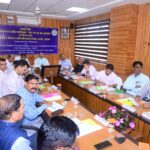
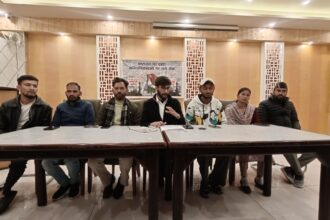
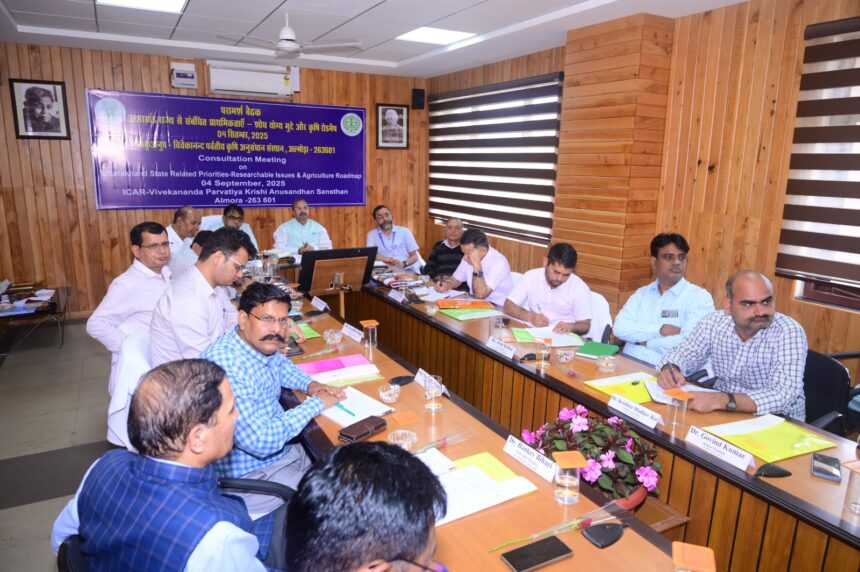
Almora. A consultation meeting on “State Priorities – Agricultural Research Issues and Roadmap” was organized by ICAR–Vivekananda Parvatiya Krishi Anusandhan Sansthan (VPKAS), Almora at its Hawalbagh campus auditorium. The meeting also included discussions on the upcoming Viksit Krishi Sankalp Abhiyan (October 3–18, 2025). The program commenced with the Council song.
Welcoming all dignitaries, Dr. Laxmi Kant, Director of the institute, introduced the concept of the consultation meeting. Chief Guest Dr. S. P. Das, Director, ICAR–National Research Centre for Orchids, Sikkim, in his address, highlighted that the climate of Uttarakhand and Himachal Pradesh is highly favorable for flower production. He assured full cooperation from his institute for promoting floriculture in collaboration with VPKAS to enhance farmers’ livelihood.
Dr. Amit Pandey, Director, ICAR–DCFR, Bhimtal, emphasized fish farming as a means of strengthening farmers’ economy and stressed the need for marketing facilities.
Dr. A. S. Nain, Scientific Advisor, GBPUAT, Pantnagar, stressed solar fencing, hemp cultivation, land consolidation, use of fallow land for agriculture and allied activities, crop diversification (mushroom cultivation, beekeeping, quality potato seed production), and utilization of pine needles.
Dr. Ramesh Singh Nitwal, Additional Director, Animal Husbandry, Kumaon Division, underlined the importance of integrating animal husbandry with agriculture for farmers’ income growth. He shared detailed information about animal diseases, vaccination, and the need to improve fodder quality and availability.
Mr. P. K. Singh, Joint Director (Agriculture), Kumaon, emphasized the need for affordable fencing techniques and short-duration crop varieties (urad, arhar, hemp).
Mr. Avinash Singh, Assistant Director, Fisheries, Almora, suggested development of “cold container” vehicles for trout fish marketing.
Mr. Sanjay Kala, Assistant Director, Sericulture, Almora, briefed about farmer-friendly projects of the department.
Dr. Nipendra Chauhan, Assistant Director, Aroma Plant Centre, Dehradun, advocated cultivation of timur, rose, mint, and citronella along with hemp varieties to protect crops from wild animals.
Dr. K. S. Pant, Director of Research, VCSG UUHF, Bharsar, informed about research for hill farmers and production of disease-resistant walnut rootstocks.
Dr. Narendra Kumar, Chief Horticulture Officer, Almora, stressed climate-resilient horticulture, vegetable variety development, and promoting “horti-tourism” in Uttarakhand.
Dr. Arun Kishor, Head, ICAR–Central Institute of Temperate Horticulture, Mukteshwar, shared information on new apple and walnut varieties developed at the institute.
Dr. K. M. Roy, In-charge, NBPGR, Bhowali, presented farmers’ concerns collected during the earlier Viksit Krishi Sankalp Abhiyan.
Dr. Banke Bihari, Principal Scientist, ICAR–Indian Institute of Soil & Water Conservation, Dehradun, discussed crop disease and pest management and related technologies.
A representative from IVRI, Mukteshwar stressed the need for designing suitable animal shelters for conserving mountain livestock.
Representatives from various Krishi Vigyan Kendras (KVKs) and departments also shared their views. During the meeting, an in-depth discussion was also held on the theme “How to Save the Himalayas.”
In the concluding session, Dr. Laxmi Kant consolidated the diverse viewpoints and presented a draft roadmap for future agricultural research issues. The program was conducted by Dr. Kushagra Joshi, Senior Scientist, while the vote of thanks was delivered by Dr. Nirmal Kumar Hedau, Head, Crop Improvement Division.